


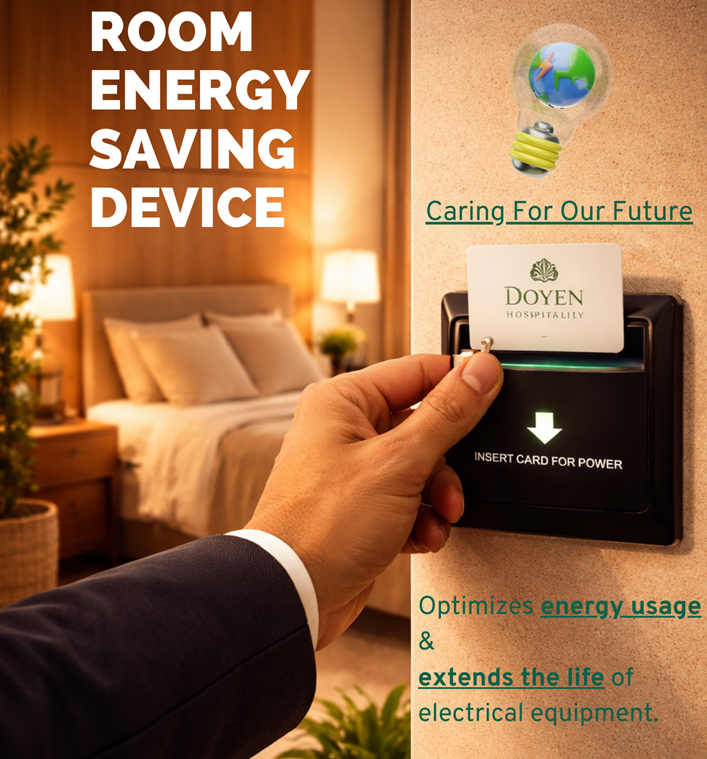
Hotel guest rooms consume electricity 24×7, even when unoccupied.
Without automation, air conditioners, lighting, and power sockets remain ON unnecessarily.
Key Benefits of Energy Saving Systems in Hotels
- Reduced electricity bills
- Lower maintenance and HVAC load
- Extended equipment life
- Improved sustainability compliance
- Better guest experience
1. Hotel Key Card Energy Saving Switch (RFID)
Hotel key card energy saving switches are the most common power control solution in guest rooms.
How It Works
- Guest inserts the RFID key card into the energy saving switch
- Power supply activates automatically
- Power cuts off when the card is removed (with time delay)
Advantages
- Prevents power misuse
- Simple installation
- Compatible with hotel RFID door locks
Best For
- Budget hotels
- Business hotels
- Mid-scale hospitality properties
2. Motion Sensor Energy Saving Device (PIR Sensor)
PIR motion sensor energy saving switches detect human presence and control power automatically.
How It Works
- Detects guest movement
- Switches OFF power when no motion is detected
- Eliminates dependency on key cards
Advantages
- Fully automatic operation
- Higher energy efficiency
- Ideal for smart hotel rooms
Best For
- Luxury hotels
- Serviced apartments
- Smart hospitality projects
3. Door Sensor Based Energy Control System
Door sensors help improve HVAC efficiency by controlling power logic based on door status.
How It Works
- Detects open or closed door
- Prevents AC operation when doors are open
- Works with card switches or EMS
Advantages
- Reduces air-conditioning load
- Improves indoor energy efficiency
- Protects HVAC equipment
Best For
- Hotels with centralized air conditioning
- High-energy-consumption properties
4. Smart Room Energy Management System (EMS)
A Hotel Room Energy Management System (EMS) is the most advanced solution for modern hotels.
How It Works
- Integrates card switch, motion sensor, thermostat, and door sensor
- Connects with PMS or BMS
- Controls lighting, air conditioning, and sockets intelligently
Advantages
- Maximum energy savings (up to 40%)
- Central monitoring and analytics
- Enhanced guest comfort and automation
Best For
- 4-star and 5-star hotels
- Green and LEED-certified hotels
- New hotel construction projects
5. Master Control Switch for Hotel Rooms
A master control switch allows guests to switch OFF all lights easily from the bedside.
Advantages
- Guest-friendly design
- Reduces night-time power consumption
- Low investment, high return
Best For
- All hotel categories
Comparison Table: Hotel Room Energy Saving Devices
| Energy Saving Device | Automation Level | Energy Saving Impact | Ideal Hotel Type |
|---|---|---|---|
| RFID Key Card Switch | Basic | Medium | Budget / Business |
| PIR Motion Sensor | Medium | High | Luxury / Smart Hotels |
| Door Sensor System | Supportive | Medium | Central AC Hotels |
| Smart EMS | Advanced | Very High | 4★ / 5★ Hotels |
| Master Control Switch | Manual | Low–Medium | All Hotels |
Best Practices for Maximum Energy Savings in Hotels
- Combine card switch + door sensor
- Use EMS for high-end properties
- Set proper time delay settings
- Maintain sensors regularly
- Train housekeeping and engineering staff
Final Thoughts from a Hotel Engineering Expert
Room energy saving devices are no longer a luxury—they are a necessity in modern hotels.
Hotels that invest in smart energy control systems:
- Reduce electricity costs by 20–40%
- Improve sustainability scores
- Increase equipment lifespan
- Enhance guest satisfaction
Choosing the right hotel room energy saving solution ensures long-term operational efficiency and higher ROI.